Showing posts with label elements. Show all posts

Thursday, January 20, 2011

Chemistry for Kids, Part 1

Apparently a natural glutton for punishment, I challenged myself to teach Chemistry to 4-7 year-olds in our co-op for 6 weeks, and the task of coming up with simplified lesson plans didn't disappoint. 


Good news is, I navigated through all the rough spots and pulled from my good 'ol science background just so I could share what I compiled and taught with other teaching mamas who would be so bold as to brave such a subject with the littles. 


Even more good news: the kids loved it! The Activities we did along with this lesson are in a separate post to cut down on length.

Over the next 6 weeks, every Thursday, I'll be posting my lesson plan for the week, along with links I referenced along with other sources to give credit where credit is due- and I ask that you please do the same if you use these. Be sure to check back in for more Chem fun!


Lesson 1/Week 1: Introduction to Chemistry
Person of the Week: August Kekule (German) & Archibald Scott Couper (Scottish)
What they did: In 1858 August Kekulé (1829–1896) and Archibald Scott Couper (1831–1892), two young men from different backgrounds, independently recognized that carbon atoms can link directly to one another to form carbon chains. They both had daydreams that Carbon atoms did some sort of happy dance together, holding "hands". This meant that other elements could follow the same rule.


What is Matter?
  • Everything is made up of matter except energy, 6 types (light, heat, sound- for now; nuclear, electrical & mechanical- for later, advanced class).
  • Matter has mass, mass has weight when gravity pulls down on it. To demonstrate, hold up a heavy, dense ball & a lightweight ball of the same size for comparison and let the kids hold them as well to conceptualize that there are so many little parts, or atoms, in the denser ball that gravity has more to pull down on.
  • States of matter are Solid, Liquid, Gas and Plasma.
  • Almost everything (matter) is made up of atoms and when atoms join together they become molecules (different) or elements (same).
  • A lot of one type of atom gives us elements (ex. copper, aluminum, carbon)
  • Atoms are made up of Protons, Electrons & Neutrons, (have kids repeat the words back) Introduce the Periodic Table just so they perhaps will recognize it when they see it again. Discuss: It's like a map through the elements
  • Atoms are made up of smaller parts called protons, neutrons in the center and elections that orbit the center just like the earth orbits the sun.
  • Show them common things they'll encounter such as O-we breathe it, He-makes balloons float, is lighter than air, Al- Foil, Fe- Ferris Wheel building material, Cu-a penny or some electrical wire, Ti-Titanium shears, blades only, so they know the little letters and squares have meaning and make sense. I brought in Titanium shears, a penny, and a piece of aluminum foil in a Ziploc bag as a visual. Explain that ONLY Al is in the foil, nothing else (for all intents and purposes), Ti in the blades of the fabric shears, and Cu in the penny.
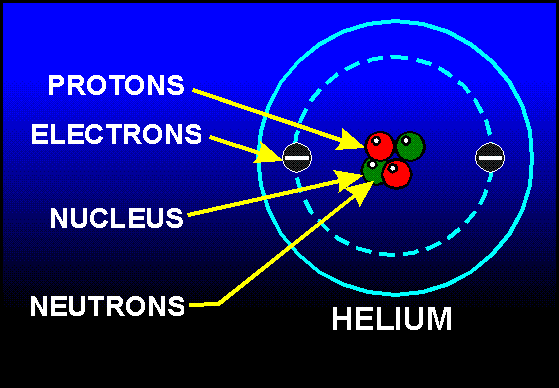
  • Draw helium atom on white board (below) and show how it correlates to the periodic table. (2e, 2p, 2n) explain that the nucleus is at the center and it's very heavy. Explain that a bunch of these Helium atoms are what make balloons float and stay up, and even though we can't see it, we know it's there because they float. Can even mention that Protons are positive and are the opposite of Electrons (ex. hot/cold, dark/light, positive/negative), which are negative and neutrons stay out of it, are neutral. P's and E's balance each other out so the atom is happy.
  • Explain: It's hard for scientists to see or take pictures of atoms because they are so small but they have made models to show what they look like so the rest of us can "see" them.
The atom is mentioned in the Qur'an when Allah says "Then anyone who has done an atom's weight of good shall see it!" Al Zalzalah 99:7


Helium Atom
Image source: http://www.tpub.com/neets/book7/0004.GIF


In a nutshell: Protons + Neutrons + Electrons(make up)-->Atoms(make up)-->Molecules (different atoms bonded together) and Elements (same atoms bonded together)


Lesson 1/Week 1- Introduction to Chemistry Links
http://www.homeschoolhelperonline.com/lapbooks/chemistry.htm
http://www.sciencetech.technomuses.ca/english/schoolzone/Info_matter.cfm
http://www.associatedcontent.com/article/2804354/homemade_lava_lamp_craft_for_kids.html?cat=24
http://www.sciencetech.technomuses.ca/english/schoolzone/matter3.cfm

Chemistry for Kids, Part 1: The Fun Stuff


The Fun Stuff for Lesson 1/Week 1 is below, as promised:


Activity: Make a 1-D model of water H2O using construction paper cutouts, above. (Cut them out ahead of time,  label them with H's and O's, put pieces in a snack-sized Ziploc bag for easy classroom distribution, and have kids glue them together- glue sticks are quick and not so messy). 
The ability of elements to form molecules gives us many different types of matter, such as water. Explain if you could see the tiniest parts of water, this is what it would look like, made up of three atoms and O gets 2 H's because it's so big, it wants to bond with 2 friends, 2 H's. When all these little molecules come together, you see water- hold up some water, a just, a cup, a glass, whatever you have.


Explain a bond in everyday terms: it's when you're close to someone, like your mom or dad or a best friend, and you just want to be with them. In the same way, elements like to hang out with one another and "bond" as well.


Activity: Show how Carbon forms chains and bonds similarly to the parts of the water molecule- stand in a straight line using long end-pieces from foamy puzzles (or just have kids join hands) and explain how Carbon/elements want to "share" their electrons, have kids share their foamy pieces, "electrons", by having each hold one end, or explain that their hands are the electrons that Carbon wants to share.

Activity: Properties of matter-Point to different objects in the room and have kids describe it, hard, soft, color, texture, shape, smell, hollow, etc.. Write the words on the white board. Give examples: glass is see-through, Aluminum is lightweight, Honey is viscous (thick), rubber is flexible, water is generally cold. Visuals are always great.


Activity:States of matterHave kids stand around in a group to do demonstrations:
Solid- stand close together and move around very slowly
Liquid- stand a little farther apart and move a little faster, floating your arms like waves
Gas- stand way apart and move around, jump around like crazy, bounce gently into walls
Plasma- (just discuss, no demo) most common form of matter, Lighting, flame, stars; the particles of plasma usually have an electric charge.

Activity: You will need 3 Ziploc sandwich bags, water something solid that will fit in the Ziploc bag (I used a building block), a clear glass or cup, and paper towels for clean-up. Fill one bag with the water, one with the solid, and the third. air, and seal up tight. Let the kids examine the bags. Then with the solid ask them if it takes up space. Take it out of the bag ask them if it changes shape. Put it in the cup ask if it changed shape to fit the cup. Have them hold it. Then ask does it have weight? Ask them if you were to drop it on the table would it pass through the table? Do it, and then ask them why it didn't. They should respond because they are both solid. 
Holding up the water bag ask them if it takes up space. Hand them the bag and ask if it has weight. Does it have a shape? Now open the bag and pour some of it into the cup. Did it change its shape to fit the cup? Ask them what would happen if you poured some on the table. Pour a little on the table and ask them what happened- they'll love this part; spilling on purpose?! *gasp*. 
Holding up the bag of air ask them if it takes up space. Hand them the bag and ask if it has weight. Not much but there is some. Ask them if it has shape. Ask what would happen if you opened the bag. Open the bag and let some out. Did it change shape? Where did it go? Explain that it couldn't wait to get out and spread out, filling the room.

Experiments/Craft(Do whatever time allows)
1. Have kids make a collage of solids, liquids & gases from mag clippings. If you can find plasmas, great! If not, having them draw a star, or some lightning will do, or, just leave it out- your call.

2. Fill a glass jar with sand- I borrowed from our sandbox. Ask the children if there is still any space in the jar. Now fill a measuring cup with water and allow the kids to take supervised turns adding what they can to the jar. Ask the children how much water was added to the jar by asking them to subtract the quantity left in the measuring cup from the original amount. Watch for bubbles coming up and out near the lip of the jar, this is the water pushing the air out as it fills the space. Also, watch for the seepage of water as it travels down the jar, making the sand a darker shade. The amount of water added represents the amount of space left in the jar. Discuss with the students the idea that there is always space around particles. There is space around each atom or molecule of any substance/anything. Also, think: Solid (sand), Liquid (water added), Gas (the air being pushed out as bubbles).

3. Make a Lava Lamp:
 A glass or plastic bottle with a cap
Water
Vegetable Oil
Alka-Seltzer (store brand) broken into several pieces
 A funnel

Do these steps in the exact order as laid out, or it won't come out right. First fill the empty bottle ¼ full of water using the funnel to keep from making a total mess. Next add food coloring. (An added fun step here...on the back of most food coloring boxes there is a chart that shows you how to mix the colors to make even more colors like purple, orange, lime green, etc. You can take this opportunity with your kids to learn about mixing colors and have some fun with it!) Fill the remaining ¾ of the bottle with vegetable oil, leaving about 1" empty from the top of the bottle. The kids will be tempted, but tell them DON'T SHAKE! Add Alka-Seltzer piece- Kids can do this part, just emphasize that they are not to put it in their mouths!! I gave their parents a packet of Alka-Seltzer to take home so they could do the demo again at home. Again, think: Solid (Alka-Seltzer), Liquid (oil and water), Gas (the bubbles created from Alka-Seltzer being dropped into oil/water mixture, causing the "lava" blobs to float).